Accredited TEFL Course for Teaching Online or Abroad From $29
Independently checked, and easy for you to check too
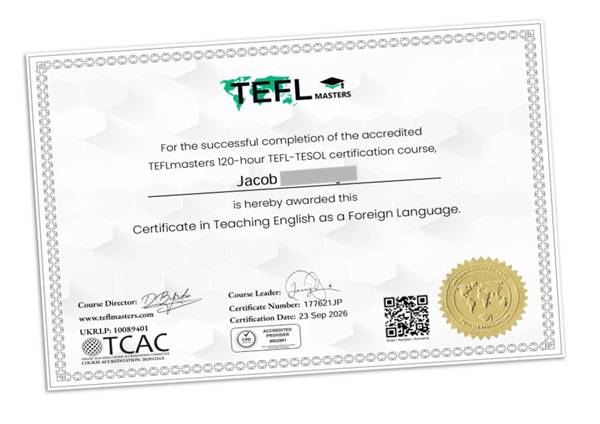
Every TEFLmasters TEFL course is accredited by OTCAC, an independent online course accreditor, and we're a CPD-verified provider on the UK Register of Learning Providers. Our courses are written by English teachers working in international schools and universities, and always have a practical aim. Pass, and your QR-verified, apostille-ready certificate is ready within seconds.
Three independent checks on every TEFLmasters course
Each card shows what the accreditation or registration means. Flip it to see how to check it yourself in under a minute.
Course accreditation
OTCAC-accredited
OTCAC is an independent online course accreditor with high standards. It reviewed our course content, assessments and certificates before accrediting them, and it also accredits other TEFL providers.
We're listed on the UK Register of Learning Providers, so you can see exactly who runs TEFLmasters. It shows we're a real, registered UK provider. It doesn't make our courses government-regulated qualifications.
CPD-verified is an independent training accreditor. It granted TEFLmasters accredited provider status, so our TEFL training also counts as continuing professional development.
There's no single official body that regulates TEFL worldwide, so it pays to know exactly what a course's accreditation covers before you buy.
What it means
An independent accreditor has reviewed our course content, assessments and certificates.
Your certificate suits around 95% of the entry to mid-tier TEFL job adverts we checked, online and in the classroom.
Graduates have used it in teaching visa applications for South Korea, China, Vietnam, Thailand and Taiwan.
Employers can check your certificate in seconds with its QR code.
It can be notarized and apostilled for work visas.
What it doesn't mean
It isn't CELTA or DELTA, and we'll never equal them. Those are intensive, observed courses at a much higher price.
It isn't an Ofqual-regulated Level 3 or Level 5 award. We're not Level 5 yet.
A few employers, such as the British Council and some European schools, ask for CELTA, DELTA or Level 5 by name, and they say so in the job advert.
No TEFL course replaces a degree where a country needs one for a work visa.
What we are: an unusually high-quality TEFL course for the price, one that actually teaches you how to teach English.
Practical by design
Our TEFL courses always have a practical aim
Every unit trains you with real teaching decisions like the four below, and selected units show real ESL classroom videos. From Premium up, you can also add practical assignments or demo lessons marked by a tutor. Pick an answer and see why it works or doesn't.
14 teenagersA2 levelAim: talk about weekend plans using "going to"
1. Warm-up2. Presenting3. Checking4. Speaking
For demonstration only. In the course, lesson flows are longer and come in many visual styles, from gamified to more formal.
TEFL curriculum
26-unit TEFL course outline
The accredited 120-hour core that every TEFLmasters course is built on: 24 units written by working English teachers, plus a midterm and final exam. The 168 and 220-hour courses add young learners, teaching adults and Business English. Tap a filter to explore.
1TEFL Introduction
2Parts of Speech
3ESL Teaching
4Classroom Management
5Present Tenses
6Motivating Learners
7Student-Centered Learning
8Culture
9Present Tenses Review
10Teaching Methods
11Planning Lessons
12Midterm Exam
13Past Tenses
14Advanced Grammar
15Teaching Vocabulary
16Teaching Productive Skills
17Teaching Pronunciation
18Teaching Receptive Skills 1
19Teaching Receptive Skills 2
20Feedback and Assessment
21Classroom Equipment
22Games in Teaching
23Online TeachingPremium
24Teaching Different Contexts
25Finding Work
26Final Exam
The $29 Online Specialist course covers online teaching throughout the units. Premium adds the dedicated Online Teaching unit and a bonus unit on teaching with textbooks.
Before you buy any TEFL course
How to check a TEFL course is properly accredited
Use these five checks on any provider, including us. A real accredited TEFL course passes all of them.
Find the accreditor's nameA proper course names who accredits it and shows a reference number. "Internationally recognized" on its own means nothing.
Make sure the accreditor is independentThe accreditor should be a separate organization that reviews several providers, not a body set up by the course provider itself.
Look the provider up yourselfGo to the accreditor's own website, not a link the provider gives you, and find the course on its list.
Check the hours and the assessmentMost employers ask for at least 120 hours, with real quizzes and exams you have to pass.
Check the certificate can be verifiedEmployers and visa offices need to confirm it's real. A QR code or online record makes that quick.
Four accredited courses
Start your accredited TEFL course from $29
Most people choose the $49 Premium course. Every course is self-paced and comes with a QR-verified, apostille-ready certificate.
Put your training into practice with feedback from a real tutor. Choose one when you enroll. Add-ons aren't available with the $29 course.
Practical Assignments +$20
4 tasks marked by a tutor within 24 hours: 2 lesson plans, 1 error correction activity and 1 behavior management system.
Practical Demos +$40
2 lesson plans and 2 recorded demo lessons (5 minutes, then 8 to 10 minutes), plus 1 ESL learner error correction task, all marked by a tutor, so you can show employers how you teach.
Apostille-ready
Your TEFL certificate can be notarized and apostilled
Our graduates have used their TEFLmasters certificates successfully in teaching visa applications for South Korea, China, Vietnam, Thailand, Taiwan and more.
About £80, and we make no money from it
Our UK notary partner handles the whole apostille in the UK and posts your certificate anywhere in the world for a small extra fee. You don't need a hard copy: your digital certificate is all they need.
New reviews appear on these sites in real time. We don't update this page every time one comes in, so click through to read the latest.
Accredited TEFL course FAQ
TEFL accreditation FAQs
Yes. Every TEFLmasters course is accredited by OTCAC (references 20210112A and 20210112B). TEFLmasters is also a CPD-verified accredited provider (reference 002991) and a UK registered learning provider (UKPRN 10089401).
OTCAC, an independent online course accreditor. It reviewed our course content, assessments and certificates before accrediting them, and it also accredits other TEFL and teacher-training providers, including Premier TEFL, The TEFL Institute, StudyTEFL, IntrepidTEFL and TEFLproAcademy.
Find TEFLmasters on the OTCAC list at otcac.com/accredited, search UKPRN 10089401 at ukrlp.co.uk, and look us up at cpd-verified.com with reference 002991. You don't need to take our word for it.
No. There's no single official body that regulates TEFL worldwide. Independent accreditors review TEFL courses, and a smaller number of courses, such as CELTA and Ofqual-regulated Level 5 awards, sit inside national qualification systems.
No. We're not Level 5 yet, and we'll never equal CELTA or DELTA. Our courses are accredited TEFL-TESOL courses that suit around 95% of the entry to mid-tier TEFL job adverts we checked.
Most will. Our graduates have found work with employers such as EF English, Cambly, VIPKid, Preply and EPIK in South Korea. A few employers ask for CELTA, DELTA or Level 5 by name, and they say so in the job advert.
Yes. Graduates have used their TEFLmasters certificates in teaching visa applications for South Korea, China, Vietnam, Thailand and Taiwan. Certificates can be notarized and apostilled through our UK notary partner for about £80, and we make no money from it.
Every certificate has a QR code that opens your online record, and employers can also check it on our certificate verification page.
Yes, for most jobs. 120 hours is the standard most TEFL employers ask for, online and in the classroom. Our 168 and 220-hour courses add young learners, teaching adults and Business English if you want more.
Every course has a practical aim, with scenario tasks and lesson flows in every unit. Every course from Premium up also includes lesson plans with instant, tutor-written feedback, and you can add Practical Assignments (+$20) or Practical Demos (+$40), where your lesson plans and demo lessons are marked by a tutor.
Between $29 and $69 USD, paid once: $29 for the 120-hour Online Specialist course, $49 for 120-hour Premium, $59 for 168 hours and $69 for 220 hours. You can add Practical Assignments (+$20) or Practical Demos (+$40) to any course except the $29 one. Your digital certificate is included.
There's a 14-day money-back guarantee on unused courses. A full refund isn't possible once you've gone beyond Unit 4. See the terms for details.
You'll go to our learning platform, tefl.institute, to pay securely by card or PayPal. Create your login there and start straight away on any device.
14-day money-back guarantee
Manage Cookie Consent
We use cookies to optimize our website for an enhanced user experience.
FUNCTIONAL
Always active
The technical storage or access is strictly necessary for the legitimate purpose of enabling the use of a specific service explicitly requested by the subscriber or user, or for the sole purpose of carrying out the transmission of a communication over an electronic communications network.
Preferences
The technical storage or access is necessary for the legitimate purpose of storing preferences that are not requested by the subscriber or user.
Statistics
The technical storage or access that is used exclusively for statistical purposes.The technical storage or access that is used exclusively for anonymous statistical purposes. Without a subpoena, voluntary compliance on the part of your Internet Service Provider, or additional records from a third party, information stored or retrieved for this purpose alone cannot usually be used to identify you.
Marketing
The technical storage or access is required to create user profiles to send advertising, or to track the user on a website or across several websites for similar marketing purposes.


 Talk to a real person